
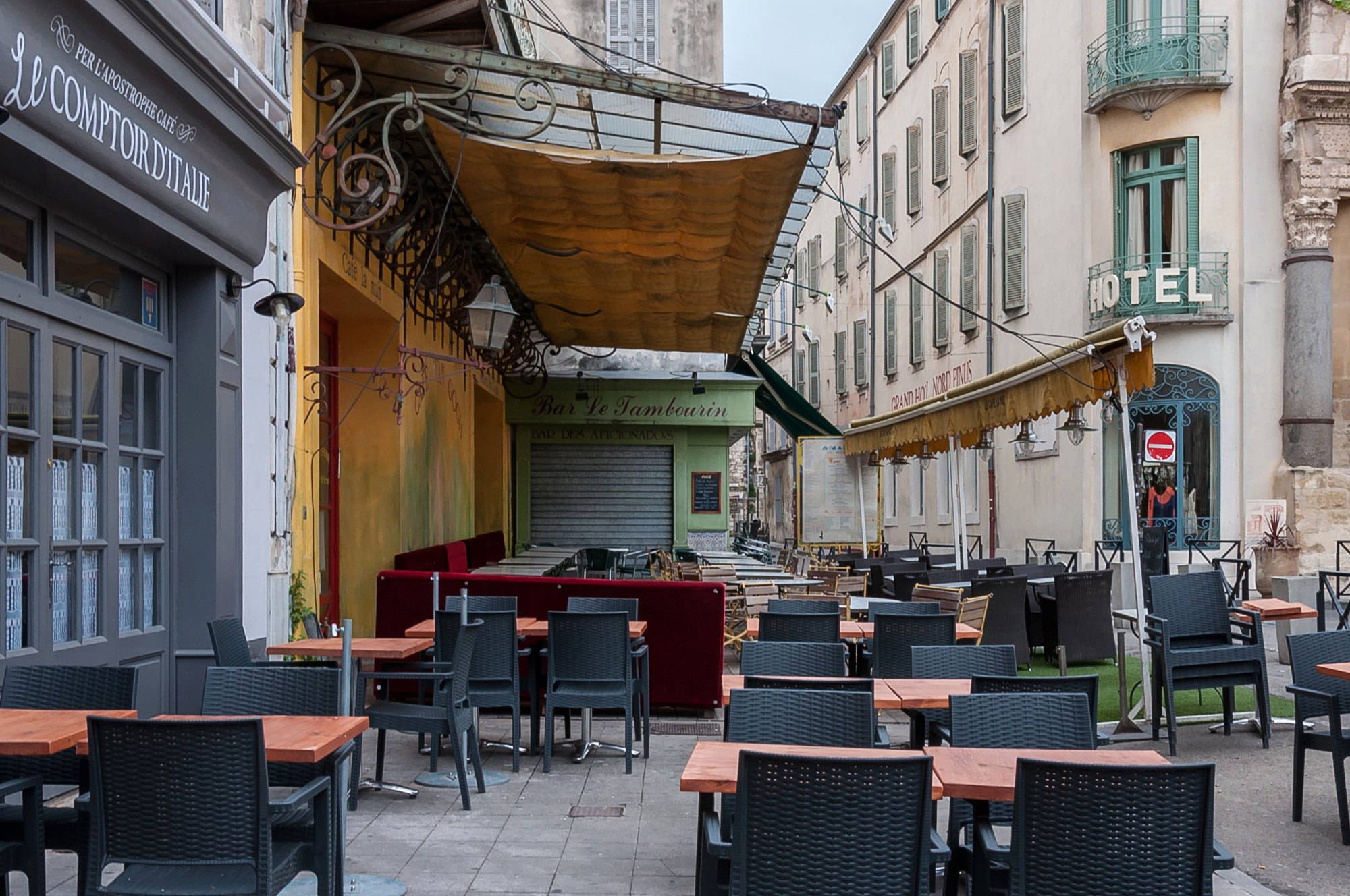
Header image: the café terrace on the Place du Forum in Arles, which Van Gogh painted at night in September 1888. Photo: Isiwal, CC BY-SA 3.0, via Wikimedia Commons.
Van Gogh arrived in Arles, in Provence, in February 1888: on the 20th according to the Fondation Vincent van Gogh Arles, on the 21st according to Wikipedia. In May he rented the Yellow House; on October 23 Paul Gauguin joined him; and on December 23 he suffered a crisis, after which he was treated at the town hospital. On May 8, 1889, he left the town to admit himself voluntarily to the asylum in Saint-Rémy.
This guide takes you through the places in and around Arles connected with his paintings: what is there today, what remains of what he saw, and which works he painted there, each with its own page.
Van Gogh’s places in Arles, one by one
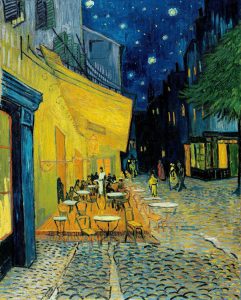
The café terrace on the Place du Forum
To paint Café Terrace at Night, Van Gogh set up his easel on the northeast corner of the Place du Forum, and today anyone can stand on that very spot. The café was remodeled in 1990 and 1991 to look like the painting and is now called Le Café La Nuit. It is not the café in The Night Café: that was a different establishment, the Café de la Gare, at 30 Place Lamartine.
Espace Van Gogh (the former Arles hospital)
After his crises, Van Gogh was treated at the town’s old hospital, the Hôtel-Dieu, where he painted and drew the garden courtyard and one of the wards. That courtyard is now called Espace Van Gogh and is a center devoted to his work.
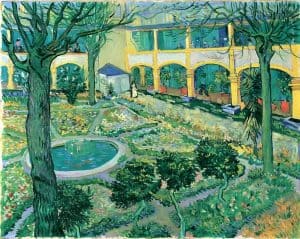 The Courtyard of the Hospital at Arles
 Courtyard of the Hospital in Arles (drawing)
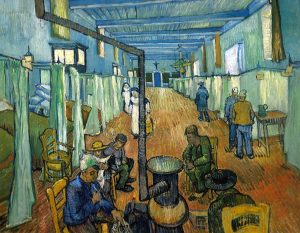 Ward in the Hospital in Arles
The Langlois Bridge and the “Pont Van Gogh”
The drawbridge Van Gogh painted in several versions no longer exists: in 1930 it was replaced by a concrete bridge, which German troops blew up in 1944 as they retreated. The bridge now called the Pont Van Gogh is another drawbridge on the same canal, identical to the Langlois Bridge: the one from Fos-sur-Mer, the only one that survived. It was dismantled in 1959, and in 1962 Arles installed it on the canal, a few kilometers downstream from the original site. So it is not the bridge Van Gogh painted.
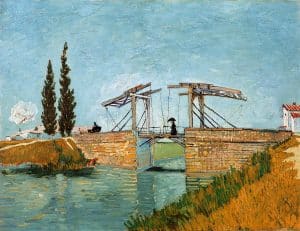 The Langlois Bridge
 The Langlois Bridge (Van Gogh Museum)
 The Langlois Bridge with Women Washing (Kröller-Müller Museum)
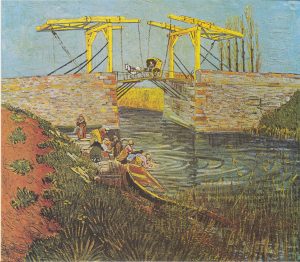 The Langlois Bridge with Women Washing (private collection)
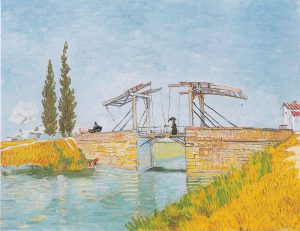 The Langlois Bridge with a Lady with a Parasol
Les Alyscamps
This ancient Roman necropolis, a World Heritage Site, has been partly restored as an open-air museum. In late October 1888, shortly after Gauguin arrived, it was the first place the two painters chose to work together, side by side.
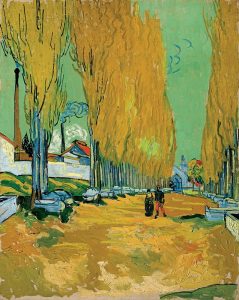
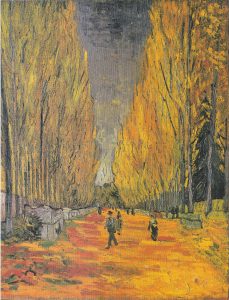
Place Lamartine: the site of the Yellow House
The house Van Gogh rented in May 1888, at 2 Place Lamartine, no longer exists: an Allied bombing raid damaged it on June 25, 1944, and it was later demolished. Only a plaque marks where it stood.

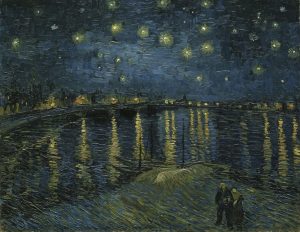
The banks of the Rhône
For Starry Night Over the Rhône, Van Gogh stood on the quay on the east bank of the river, a minute or two’s walk from the Yellow House, and looked southwest from the Place Lamartine.
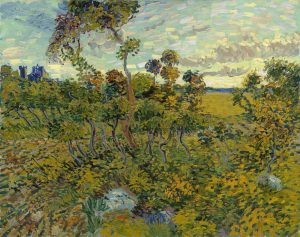
Montmajour Abbey
About 5 kilometers north of Arles, the abbey is now a historic monument cared for by the Centre des monuments nationaux. Van Gogh often painted and drew the abbey and the surrounding landscape: in July 1888 he told Theo he had been there at least fifty times to look at the view over the plain.


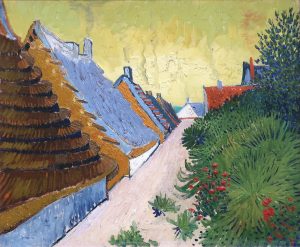
A day trip to Saintes-Maries-de-la-Mer
In late May and early June 1888 Van Gogh spent a few days in this coastal village. He brought back nine drawings and two paintings, a seascape and a view of the village, and back in Arles he painted other works based on those drawings, such as the boats on the beach.

Museums and visits
Fondation Vincent van Gogh Arles. A contemporary art center devoted to Van Gogh’s work and legacy, in the Hôtel Léautaud de Donines (35 ter, rue du Docteur-Fanton). It hosts temporary exhibitions: in October 2026 its website lists “SUSPECTS — Van Gogh, Tricksters & Co.” Official website: fondation-vincentvangogh-arles.org.
Montmajour Abbey. A monument managed by the Centre des monuments nationaux; it is the place Van Gogh drew again and again in 1888. Official website: abbaye-montmajour.fr.
Getting there and where to stay
Arles has a train station, with direct TGV trains to Paris and regional TER trains to Marseille, Avignon, Nîmes and Montpellier. From the station to the Fondation Vincent van Gogh it is a little over a kilometer on foot. To do the route on foot, the practical choice is to stay in the center of Arles.
More on Van Gogh in Arles
The full period, with its main works, is covered in Arles (1888–1889). To find out which museums around the world hold his paintings today, see where to see Van Gogh’s paintings.
Sources: official website fondation-vincentvangogh-arles.org; English Wikipedia articles “Café Terrace at Night”, “Arles”, “Langlois Bridge”, “Alyscamps”, “The Yellow House”, “Starry Night Over the Rhône”, “Fondation Vincent van Gogh Arles”, “Montmajour Abbey”, “Saintes-Maries-de-la-Mer”, “The Night Café”, “Les Alyscamps” and “Saintes-Maries (Van Gogh series)”; French Wikipedia article “Pont Van-Gogh”; the page for each work on museovangogh.org; photo from Wikimedia Commons.