
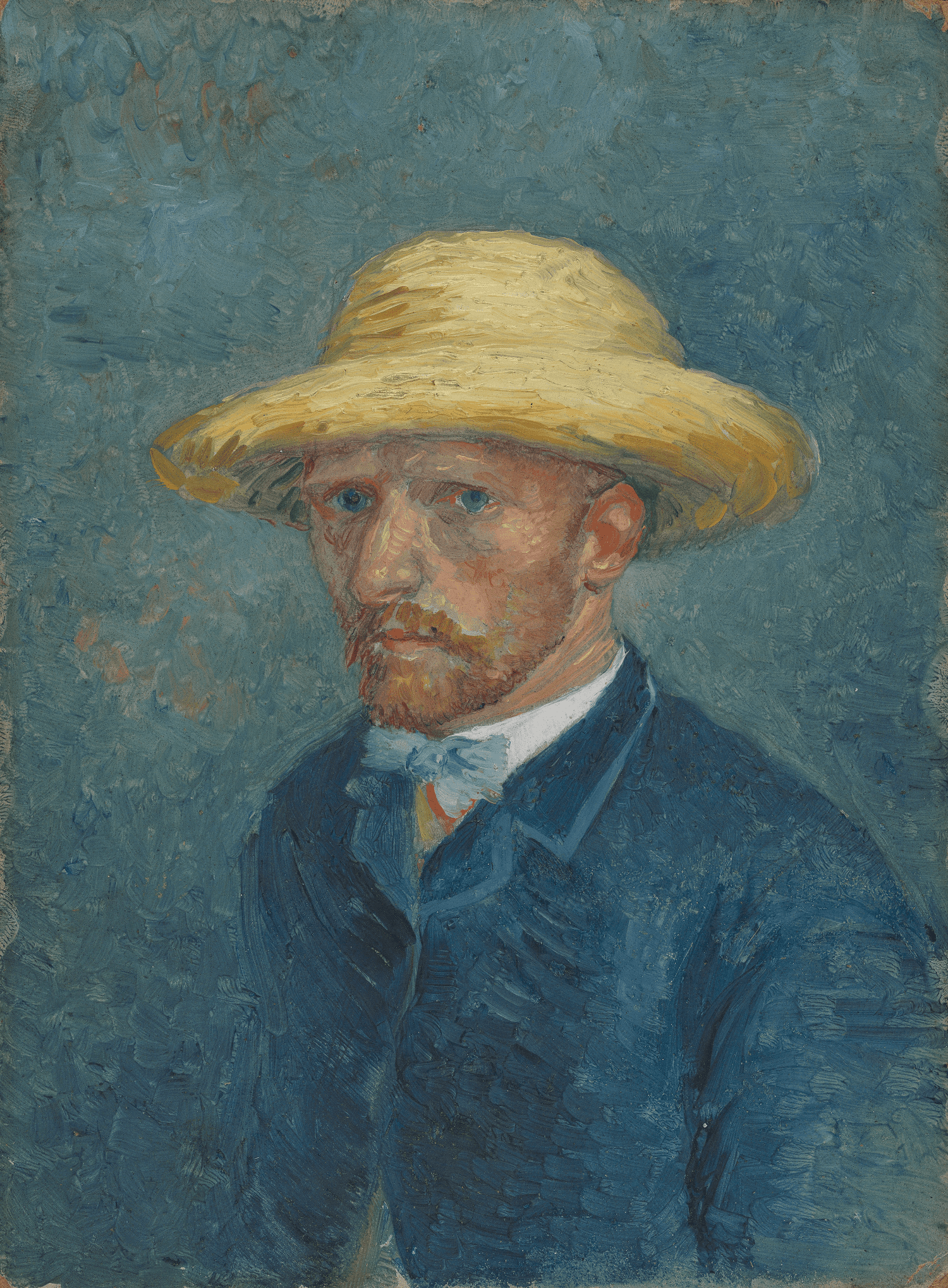
Theo van Gogh, Theodorus van Gogh (Zundert, May 1, 1857 – Utrecht, January 25, 1891), was a Dutch art dealer and the younger brother of Vincent van Gogh. From 1881 he ran the Boulevard Montmartre branch of Goupil & Cie (later Boussod, Valadon & Cie) in Paris, where he showed Monet, Degas and Pissarro. From 1881 he also supported Vincent financially, and he received the vast majority of his letters. According to the Van Gogh Museum, without him Vincent would probably never have become an artist. Theo died at 33, six months after his brother, and since 1914 he has been buried beside him in Auvers-sur-Oise.
Childhood in Zundert and the Van Gogh family (1857–1872)
Theo was born in the parsonage at Zundert, a village in North Brabant. He was the third child of the Protestant minister Theodorus van Gogh and Anna Cornelia Carbentus, after Vincent and Anna; Elisabeth (Lies), Willemien (Wil) and Cor, the youngest, came later. Vincent was four years older, but the two brothers sought each other out: they shared a bedroom in the attic, and Theo looked up to his older brother, who told him about nature. He was seven when Vincent went away to boarding school, and from then on they only saw each other during the holidays.
In September 1872, at 15, Theo spent a few days in The Hague with Vincent, who was already working for Goupil, and after returning home he received the first letter from Vincent that he kept: “I missed you the first few days, and it was strange for me not to find you when I came home in the afternoon” (letter 1, September 29, 1872).
Art dealer at Goupil & Cie: Brussels, The Hague and Paris (1873–1890)
Theo followed in his brother’s footsteps. On January 1, 1873 he joined the Brussels branch of Goupil & Cie as its youngest employee, at 15, a year younger than Vincent had been when he started. In November of that year he moved to the branch in The Hague, the former gallery of his uncle Vincent, a partner in Goupil. While Theo thrived, Vincent was dismissed in 1876. By the age of 23 Theo was working at the Paris house, and in 1881 he was put in charge of the branch at 19 Boulevard Montmartre. The firm passed to Goupil’s son-in-law and from 1884 was called Boussod, Valadon & Cie; Theo kept his post.
According to his contract and his account book, he earned a base salary of 4,000 francs a year plus 7.5% of the branch’s profits: about 12,000 francs a year. With that he supported Vincent, but he also sent money to his parents and helped pay for the education of his younger siblings, Willemien and Cor.
His financial support for Vincent
Between 1878 and 1880, when Vincent was a preacher in the Borinage mining region of Belgium, the brothers drifted apart. Theo visited him and found him neglected and out of work, and for almost a year they did not write to each other. It was a remittance from Theo that made Vincent take up his pen again (letter 155, 1880). According to the edition of the letters, it was Theo who suggested he become an artist. Vincent’s career became a joint project for the two of them, and in 1881 Theo committed to supporting him.
From June 1882 he sent him money three times a month, around the 1st, the 10th and the 20th. In early 1884 Vincent proposed a deal: the money would be a payment, and in return all his drawings and paintings would belong to Theo. Theo agreed, although he warned him that his work was too dark to sell. The edition of the letters estimates that, in total, Theo gave him some 17,500 francs, about 14.5% of his income; in Arles, in 1888, Vincent had between 220 and 260 francs a month, while his friend the postman Roulin had 135 a month to feed five people. Theo never saw it as a debt. In April 1889 he wrote to him: “you’ve given it back to me several times over, both by your work and by a brotherly affection which is worth more than all the money I’ll ever possess” (letter 762, April 24, 1889).
The letters: 651 from Vincent and 39 from Theo
Vincent’s surviving correspondence comprises 820 letters he wrote and 83 he received. According to the critical edition at vangoghletters.org, 651 are addressed to Theo, and from the last months there are also several to Theo and Jo together; only 39 letters from Theo to Vincent survive. Theo kept everything, while Vincent threw away or burned many letters; 37 of Theo’s date from 1888–1890, and for those years the dialogue is almost complete. Theo was his sounding board on matters of art and his confidant on family and love affairs. The edition points out that, with nearly all of Theo’s letters missing, the relationship looks one-sided, but his letters to Jo show how much he depended on Vincent too. More in Van Gogh’s letters.
Two years together in Paris: Rue Laval and Rue Lepic (1886–1888)
Theo wanted Vincent to get to know modern painting in Paris and invited him to come once he had a larger apartment. Vincent did not wait. In late February 1886 he arrived unannounced from Antwerp and left him a note: “My dear Theo, Don’t be cross with me that I’ve come all of a sudden. I’ve thought about it so much and I think we’ll save time this way. Will be at the Louvre from midday, or earlier if you like” (letter 567, on or about February 28, 1886).
At first they lived in Theo’s apartment at 25 Rue Laval, too small for the two of them. In early June 1886 they moved to a roomier apartment at 54 Rue Lepic, also in Montmartre, where Vincent had his own studio. From its windows he painted the View from Theo’s Apartment. Those streets are part of our Montmartre route.
Living together was not easy. In March 1887 Theo wrote to his sister Willemien that life at home had become almost unbearable, although a few weeks later he gave her more reassuring news. According to the edition of the letters, those two years brought them even closer: Theo became convinced that Vincent’s work would eventually sell. Because they lived together they hardly wrote to each other, and it is the most poorly documented period of Vincent’s life; we cover it in Van Gogh in Paris (1886–1888). In February 1888 Vincent left for Arles, and Theo paid for his train ticket.
Dealer for the Impressionists and for Gauguin
From the second half of 1887, Theo began cautiously showing avant-garde artists at the Boussod, Valadon & Cie gallery. He persuaded his employers to buy and exhibit Impressionists such as Claude Monet and Edgar Degas, competing with Durand-Ruel and Georges Petit. In June and July 1888 he showed ten landscapes that Monet had just painted in Antibes, as our Claude Monet biography explains. Degas let him show his nudes in January 1888, and of Camille Pissarro, with whom he was close, he presented works in 1888 and gave him an exhibition in 1890.
His role with Paul Gauguin was decisive for Vincent. Theo persuaded him to join Vincent in Arles and paid for his journey and his keep; in 1888 he sent 2,900 francs to Arles, 400 of them for Gauguin. When their life together ended in December with the crisis in which Vincent cut off his ear, Theo took the night train to Arles on Christmas Eve and returned to Paris with Gauguin. The full story is in the relationship between Van Gogh and Paul Gauguin. In July 1890 he told Vincent that he had sold two Gauguins and that he would advance money to Pissarro, who could not pay his rent (letter 897).
Marriage to Jo Bonger and the birth of Vincent Willem (1889–1890)
In Paris Theo was friends with Andries Bonger, and through him he met his sister Johanna. They married in Amsterdam in April 1889: Wikipedia gives April 17, but the edition of the letters dates the wedding to the 18th, the date on the announcement Vincent received (letter 759). Vincent did not attend, but he congratulated them by letter. We tell Jo’s life story in the biography of Johanna van Gogh-Bonger.
On January 31, 1890 their son was born in Paris, and they named him Vincent Willem, after his uncle. It was a special honor, because the custom was to name a boy after his paternal grandfather. Vincent painted Almond Blossom for the baby. In May 1890, on his way to Auvers, Vincent met his nephew at Theo’s apartment. Jo would recall the two brothers gazing silently at the cradle, with tears in their eyes.
Vincent’s death in Auvers (July 1890)
Theo found his brother a place near Paris under the watch of a doctor, Dr. Gachet: Auvers-sur-Oise. On June 8 the family went to see him, and they had lunch in Gachet’s garden. But Theo was planning to leave Boussod and set up on his own; he told Vincent so in Paris in early July, and Vincent went back to Auvers afraid of being a burden. Theo’s last letter, of July 22, ended like this: “Enclosed I’m sending you 50 francs – write to me quickly, and believe me your brother who loves you” (letter 901, July 22, 1890). Vincent replied on the 23rd with his last letter (letter 902).
On July 27 Vincent shot himself in the chest in a field near Auvers. Theo got the news the next day, went at once and stayed by his side until the end: Vincent died on July 29, 1890. Theo wrote to his mother that this grief would stay with him as long as he lived. Six weeks later he organized an exhibition in Vincent’s memory.
Illness and death in Utrecht (1890–1891)
Theo’s health had never been good. After the exhibition he left Boussod and suffered a severe nervous breakdown. He was first admitted in Auteuil; at Jo’s request he was transferred to a psychiatric institution in Utrecht, where he was admitted on November 18, 1890. There he was diagnosed with dementia paralytica, the final stage of syphilis, and there he died on January 25, 1891, at 33, six months after his brother. He was buried in the Soestbergen cemetery in Utrecht.
Together in Auvers-sur-Oise: the 1914 reburial
In 1914, the same year she published Vincent’s letters to Theo, Jo had her husband’s remains exhumed and moved to the cemetery in Auvers-sur-Oise, beside Vincent’s grave, so that the two brothers could rest together. The two identical headstones read “Ici repose Vincent van Gogh (1853–1890)” and “Ici repose Theodore van Gogh (1857–1891)”. They are on our Van Gogh route through Auvers-sur-Oise.
Self-portrait or portrait of Theo?
No portrait of Theo by Vincent is known for certain. The best known is a small painting in the Van Gogh Museum, painted in Paris in the summer of 1887 (oil on cardboard, 19 × 14.1 cm), which now carries a double title: Self-Portrait or Portrait of Theo van Gogh. For a long time it was considered a self-portrait of Vincent; in 2011 it was suggested that the sitter was Theo. The museum explains that the brothers looked remarkably alike and that there is no conclusive evidence of who it is.
Legacy: Jo, Vincent Willem and the Van Gogh Museum
Theo died without seeing his brother’s success, but his judgment as a dealer proved right, and because he kept everything (letters, photographs, accounts) much of the documentation of the two brothers survives. Vincent’s hundreds of works passed to Jo and her son, and Jo devoted her life to making them known. Vincent Willem van Gogh (1890–1978), an engineer, inherited the collection in 1925; in 1962 he transferred it to the Vincent van Gogh Foundation, and the Dutch state committed to building a museum. The Van Gogh Museum in Amsterdam opened on June 2, 1973 with the two brothers’ collection; you can find it on our Amsterdam route.
Theo van Gogh at a glance
| Name | Theodorus (Theo) van Gogh |
| Born | May 1, 1857, Zundert (North Brabant, Netherlands) |
| Died | January 25, 1891, Utrecht (Netherlands), aged 33 |
| Occupation | Art dealer at Goupil & Cie, later Boussod, Valadon & Cie (manager of the Boulevard Montmartre branch, Paris, from 1881) |
| Parents | Theodorus van Gogh and Anna Cornelia Carbentus |
| Spouse | Johanna Bonger (married in Amsterdam, April 1889) |
| Son | Vincent Willem van Gogh (1890–1978) |
| Burial | Auvers-sur-Oise cemetery, beside Vincent (since 1914; previously Soestbergen cemetery, Utrecht) |
To keep reading, see the biography of Vincent van Gogh or that of his great friend and rival, Paul Gauguin.
Sources: Van Gogh Museum, “Brotherly love”, “The brothers Vincent and Theo”, “Vincent’s death”, “After Vincent’s death”, “Without family, no museum” and the entry for “Self-Portrait or Portrait of Theo van Gogh” (vangoghmuseum.nl); vangoghletters.org, “Correspondents” (2.1 Theo; 4.1), “Biographical & historical context” (1.6, 3.1, 3.2, 4) and letters 1, 155, 218 (note 7), 555 (note 8), 567, 569 (note 9), 625 (note), 759, 762, 897, 901 and 902; Wikipedia, “Theo van Gogh (art dealer)” (en), “Theo van Gogh (kunsthandelaar)” (nl) and “Theo van Gogh (marchante de arte)” (es).