
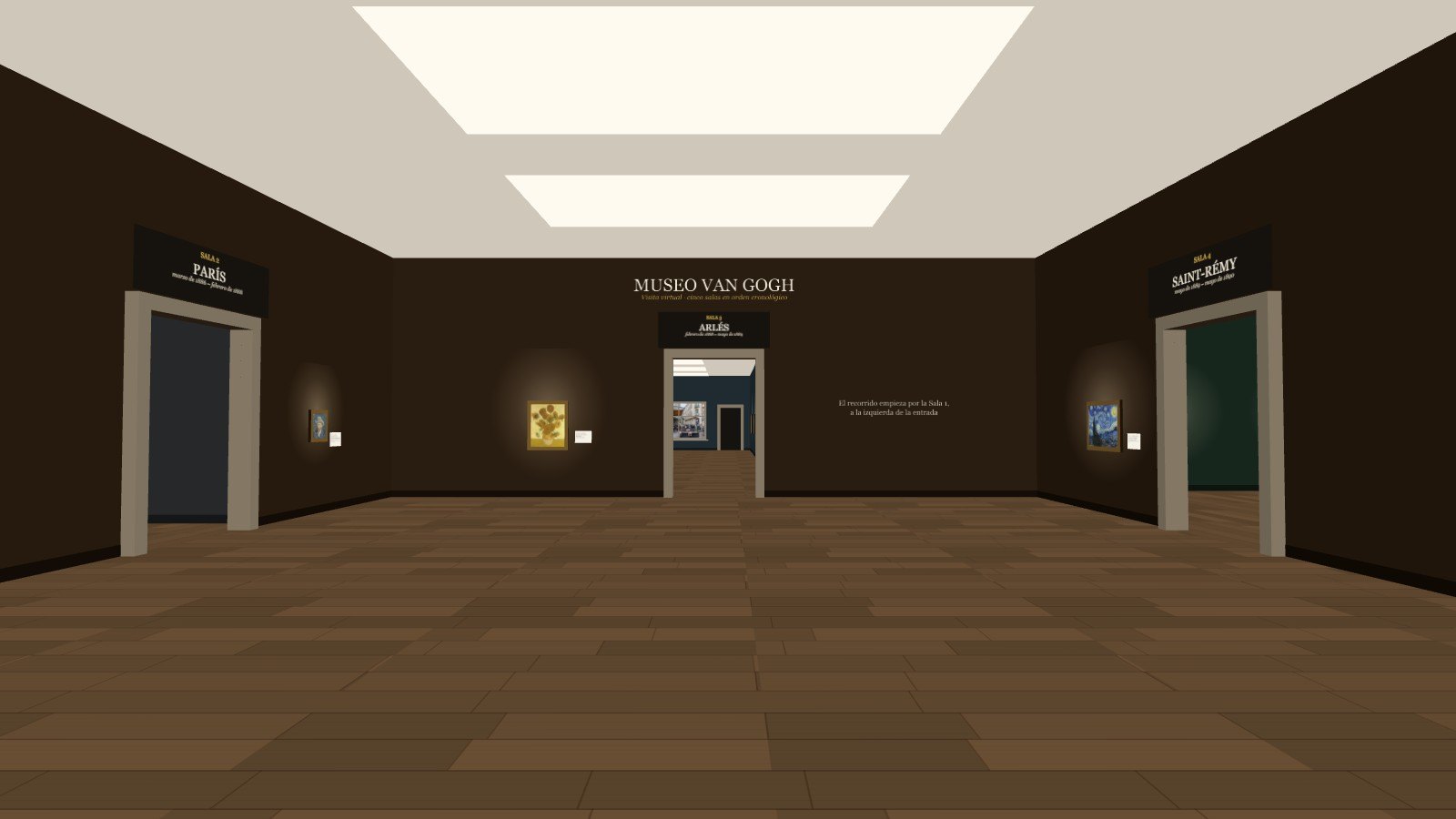
The museovangogh.org virtual tour is a 3D museum you can explore for free in your browser: five rooms, one for each period of Vincent van Gogh’s life, with 64 paintings hung at actual size and in chronological order. Tap a work and it opens in high resolution, with zoom down to the brushstroke, next to its label: title, date, the museum that holds it today and, where there is one, a quote from his letters. The tour itself and its labels are in Spanish.
Enter the virtual museum (in Spanish) →See the five rooms
What the tour is like
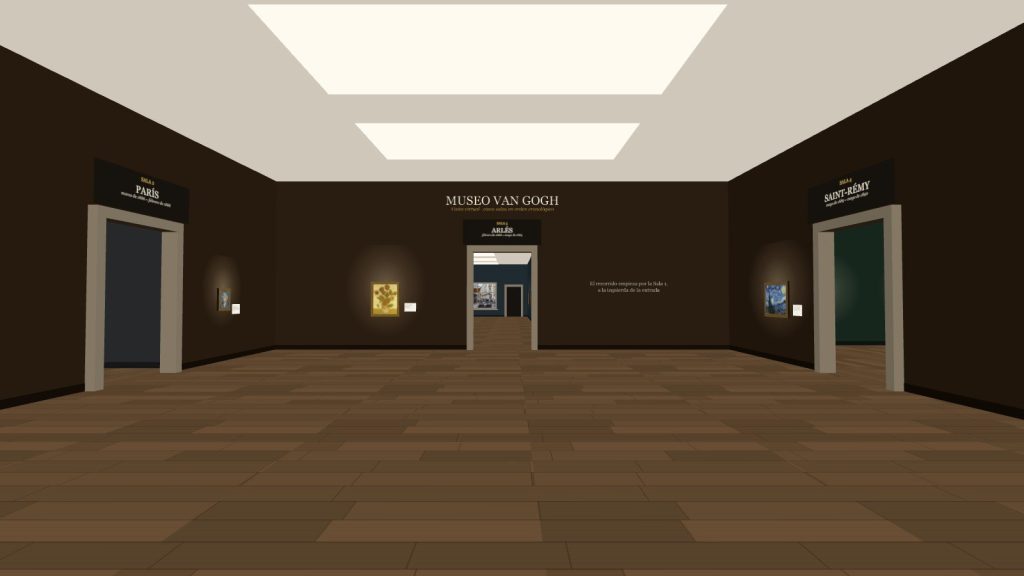
- A lobby with five doors, one for each period, with a sign above each and, beside it, a work from that period that is not inside the room, as at the entrance to a museum.
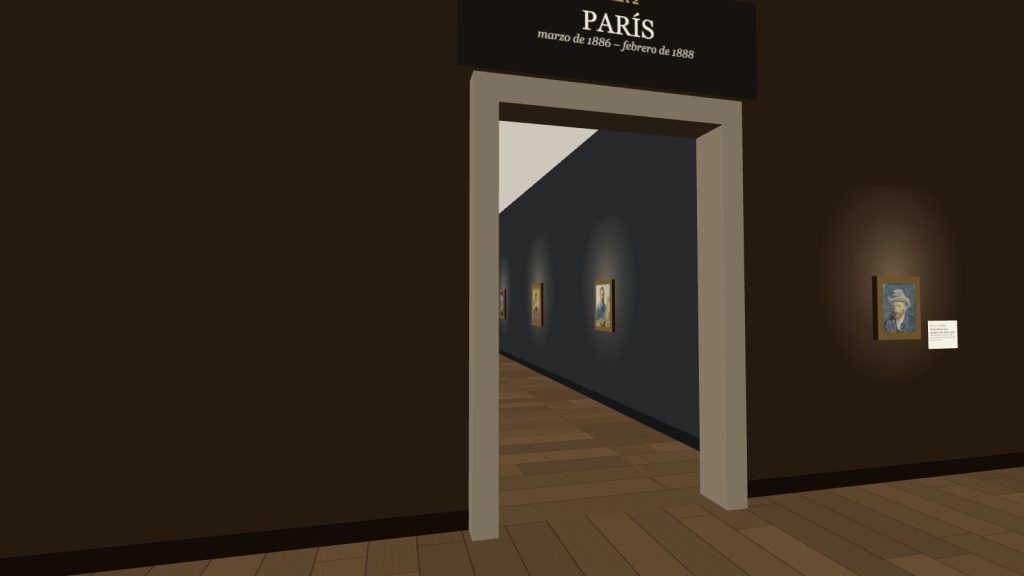
- Five rooms: Nuenen, Paris, Arles, Saint-Rémy and Auvers-sur-Oise. Through each door you see the actual room behind it, and you walk from one to the next.
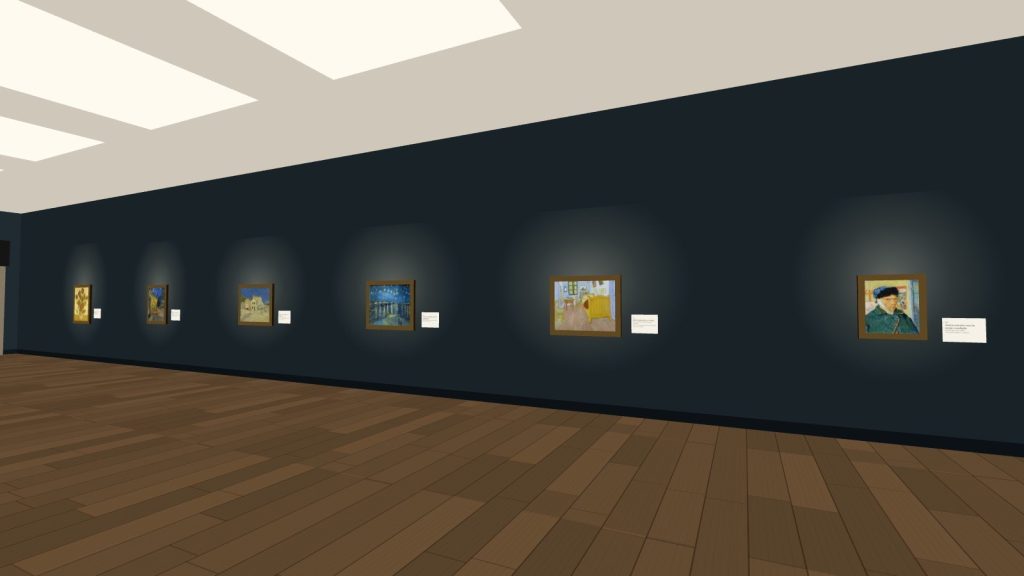
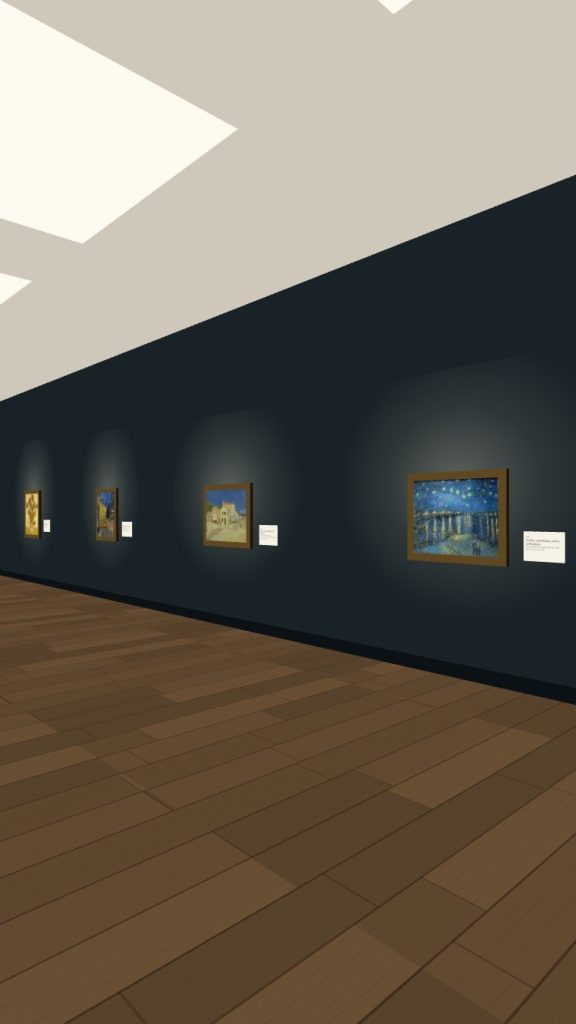
- Paintings at actual size and in the order he painted them, with their labels on the wall (in Spanish).
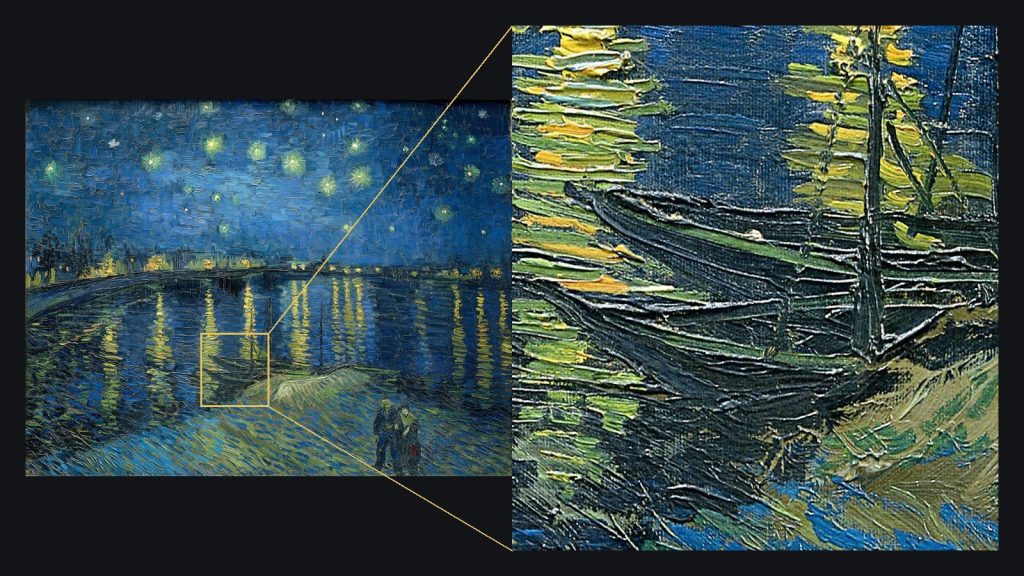
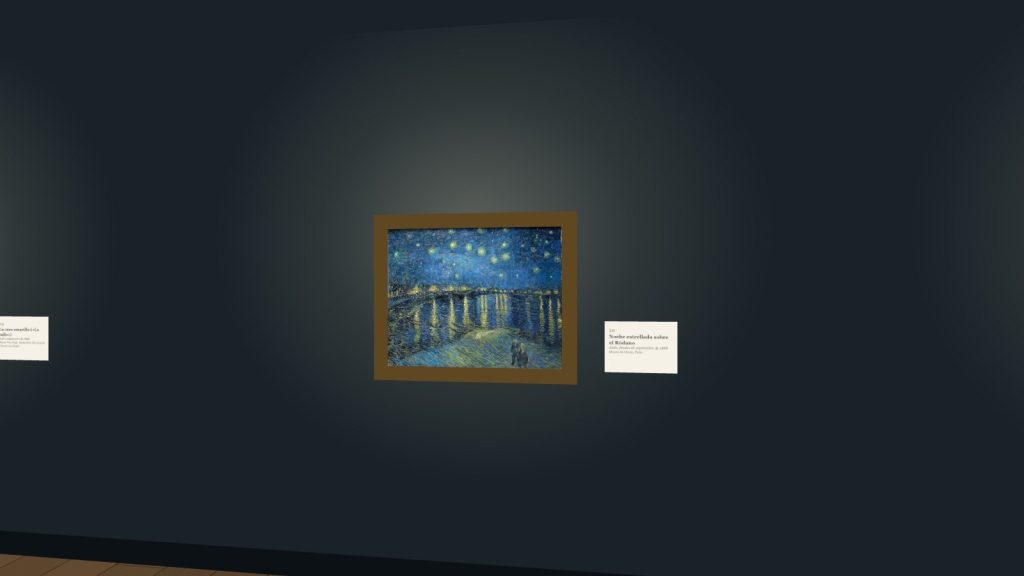
- Zoom down to the brushstroke: each work opens in high resolution, with its full label and a link to its entry.
- A window onto the travel guide in each room, to see what the places he painted look like today.
The lobby
Beside each door hangs a work from that period that is not inside the room, as at the entrance to a museum.
- Birds’ Nests (Nuenen, September–October 1885)
- Imperial Fritillaries in a Copper Vase (Paris, around April–May 1887)
- The Pink Orchard (Arles, early April 1888)
- Roses (Saint-Rémy, May 1890)
- Street in Auvers-sur-Oise (Auvers-sur-Oise, May 1890)
The five rooms
Room 1 · Nuenen (December 1883 – November 1885)
Van Gogh lived in Nuenen from December 1883 to November 1885, at first with his parents at the parsonage: he painted weavers, peasants and landscapes, and capped the period with The Potato Eaters.
Enter the Nuenen room · see its works as a list (in Spanish)
- Congregation Leaving the Reformed Church in Nuenen (Nuenen, January–February 1884, reworked in the fall of 1885)
- The Old Tower at Nuenen (Nuenen, February–March 1884)
- Weaver, Seen from the Front (Nuenen, July 1884)
- Avenue of Poplars in Autumn (Nuenen, October 1884)
- Head of a Peasant Woman (Nuenen, 1885)
- The Potato Eaters (Nuenen, April–May 1885)
- The Cottage (Nuenen, May 1885)
- The Old Church Tower at Nuenen (‘The Peasants’ Churchyard’) (Nuenen, May–June 1885)
- The Vicarage at Nuenen (Nuenen, September–October 1885)
- Still Life with Bible (Nuenen, October 1885)
- Lane with Poplars (Nuenen, November 1885, with retouching in Paris in 1886)
Room 2 · Paris (March 1886 – February 1888)
Van Gogh lived in Paris from March 1886 to February 1888 (the Van Gogh Museum and Vangoghletters date his arrival to around February 28, 1886): with his brother Theo in Montmartre (rue Laval and, from June 1886, 54 rue Lepic), where he met Toulouse-Lautrec, Bernard, Signac and Tanguy, painted Montmartre and Asnières, and left Paris for Arles on February 19, 1888.
Enter the Paris room · see its works as a list (in Spanish)
- View from Vincent’s Studio (Paris, June 1886)
- Shoes (Paris, September–November 1886)
- Le Moulin de la Galette (Paris, fall 1886)
- In the Café: Agostina Segatori in Le Tambourin (Paris, January–March 1887)
- View from Theo’s Apartment (Paris, March–April 1887)
- Wheatfield with Partridge (Paris, June–July 1887)
- Sunflowers (Paris, late summer 1887)
- Self-Portrait with Grey Felt Hat (Paris, September–October 1887)
- Flowering Plum Orchard (after Hiroshige) (Paris, October–November 1887)
- Bridge in the Rain (after Hiroshige) (Paris, October–November 1887)
- The Italian Woman (Paris, late 1887)
- Self-Portrait as a Painter (Paris, December 1887 – February 1888)
Room 3 · Arles (February 1888 – May 1889)
Van Gogh arrived in Arles on February 20, 1888, rented the Yellow House in May, lived with Gauguin from October 23, suffered the breakdown of December 23, 1888, and voluntarily entered the asylum in Saint-Rémy on May 8, 1889.
Enter the Arles room · see its works as a list (in Spanish)
- Sprig of Flowering Almond in a Glass (Arles, early March 1888)
- Bridge at Arles (Pont de Langlois) (Arles, mid-March 1888)
- Pink Peach Trees (‘Souvenir de Mauve’) (Arles, around March 30, 1888)
- Fishing Boats on the Beach at Les Saintes-Maries-de-la-Mer (Arles, June 1888)
- Sower with Setting Sun (Arles, c. June 17–28, 1888)
- La Mousmé (Arles, July 1888)
- Vase with Fifteen Sunflowers (Arles, August 1888)
- Café Terrace at Night (Arles, mid-September 1888)
- The Yellow House (‘The Street’) (Arles, September 1888)
- Starry Night Over the Rhône (Arles, late September 1888)
- The Bedroom (Arles, October 1888)
- Self-Portrait with Bandaged Ear (Arles, January 1889)
Room 4 · Saint-Rémy (May 1889 – May 1890)
Van Gogh voluntarily entered the Saint-Paul-de-Mausole asylum on May 8, 1889, and stayed there until May 16, 1890; during that year he painted the garden, the fields and olive groves around it, and the Alpilles series.
Enter the Saint-Rémy room · see its works as a list (in Spanish)
- Irises (Saint-Rémy, May 1889)
- The Starry Night (Saint-Rémy, June 1889)
- The Olive Trees (Saint-Rémy, June 1889)
- Cypresses (Saint-Rémy, June 1889)
- A Wheatfield, with Cypresses (Saint-Rémy, September 1889)
- Wheatfield with a Reaper (Saint-Rémy, September 1889)
- Self-Portrait (Saint-Rémy, September 1889)
- Pine Trees at Sunset (Saint-Rémy, December 1889)
- The Siesta (after Millet) (Saint-Rémy, December 1889 – January 1890)
- Prisoners Exercising (after Doré) (Saint-Rémy, around February 10–12, 1890)
- Almond Blossom (Saint-Rémy, February 1890)
- Irises (yellow background) (Saint-Rémy, May 1890)
Room 5 · Auvers-sur-Oise (May 20 – July 29, 1890)
Van Gogh lived in Auvers-sur-Oise from his arrival on May 20, 1890, until his death on July 29, 1890; staying in a small room at the Auberge Ravoux, he painted almost one picture a day (gardens, wheat fields, the church, portraits) and became friends with Dr. Gachet.
Enter the Auvers-sur-Oise room · see its works as a list (in Spanish)
- Thatched Cottages (Auvers-sur-Oise, around May 21, 1890)
- Stairway at Auvers (Auvers-sur-Oise, May 1890)
- Portrait of Dr. Gachet (Auvers-sur-Oise, June 1890)
- The Church at Auvers (Auvers-sur-Oise, June 1890)
- Landscape at Auvers after Rain (Auvers-sur-Oise, around June 12, 1890)
- Daubigny’s Garden (Auvers-sur-Oise, June 1890)
- Landscape with the Château of Auvers at Sunset (Auvers-sur-Oise, June 1890)
- Girl in White (Auvers-sur-Oise, June 1890)
- Farms near Auvers (Auvers-sur-Oise, 1890)
- Wheatfield under Thunderclouds (Auvers-sur-Oise, July 1890)
- Wheatfield with Crows (Auvers-sur-Oise, July 1890)
- Tree Roots (Auvers-sur-Oise, July 1890)
How to get around
- On a computer: drag with the mouse to look around; walk with W A S D or the ↑ ↓ arrow keys (← → turn), with the scroll wheel, or by clicking on the floor. Click a painting to open it.
- On a phone: drag your finger to look around and tap the floor to walk. Tap a painting to open it and pinch to zoom.
- Guided route: the ‹ › buttons at the bottom take you from painting to painting (and, in the lobby, from door to door).
- Between rooms: walk toward a door to go through it. Each room has one door to the lobby and another to the next room, except Auvers, the last one.
Where the images and texts come from
The labels summarize the entries on museovangogh.org, checked against the Van Gogh Museum’s edition of the letters, Wikipedia, vggallery.com and the museums’ websites. The images are public domain or CC0 reproductions from Wikimedia Commons, chosen to match the exact version of each painting, with its catalog number and museum.
The originals are held in 17 museums: Courtauld Gallery, London; Metropolitan Museum of Art, New York; Museum Boijmans Van Beuningen, Rotterdam; Ateneum Art Museum, Helsinki; Musée d’Orsay, Paris; State Hermitage Museum, St. Petersburg; J. Paul Getty Museum, Los Angeles; Kröller-Müller Museum, Otterlo; Museo Nacional de Bellas Artes, Buenos Aires; Pushkin Museum, Moscow; Van Gogh Museum, Amsterdam; Museum of Modern Art, New York; National Galleries of Scotland, Edinburgh; National Gallery of Art, Washington; National Gallery, London; Saint Louis Art Museum, St. Louis; Tate, London.
Frequently asked questions
Is the virtual tour free?
Yes, the museovangogh.org virtual tour is free: you explore it in your browser, with no sign-up and nothing to install, on a computer or a phone. The tour and its labels are in Spanish.
Is this the official virtual tour of the Van Gogh Museum in Amsterdam?
No. museovangogh.org is an independent project, not affiliated with the Van Gogh Museum in Amsterdam or any other museum. The paintings in the tour are held in 17 different museums, and each work’s label says which one. If you are planning a trip to Amsterdam, see our Van Gogh Museum guide and our guide to tickets.
Which paintings are in the tour?
64 works: 59 in five rooms (Nuenen, Paris, Arles, Saint-Rémy and Auvers-sur-Oise, in chronological order) and five more in the lobby. They include The Potato Eaters, Vase with Fifteen Sunflowers (National Gallery, London), Café Terrace at Night, The Starry Night and Wheatfield with Crows.
Can I use it on my phone?
Yes. On a phone you drag your finger to look around and tap the floor to walk. For basic phones, each room has a list version, without 3D, with the same zoom and the same labels.
Where do the images and quotes come from?
The images are public domain or CC0 reproductions from Wikimedia Commons, most of them made by the museums themselves. The quotes come from the Van Gogh Museum’s edition of the letters (vangoghletters.org), with a link to each letter.