
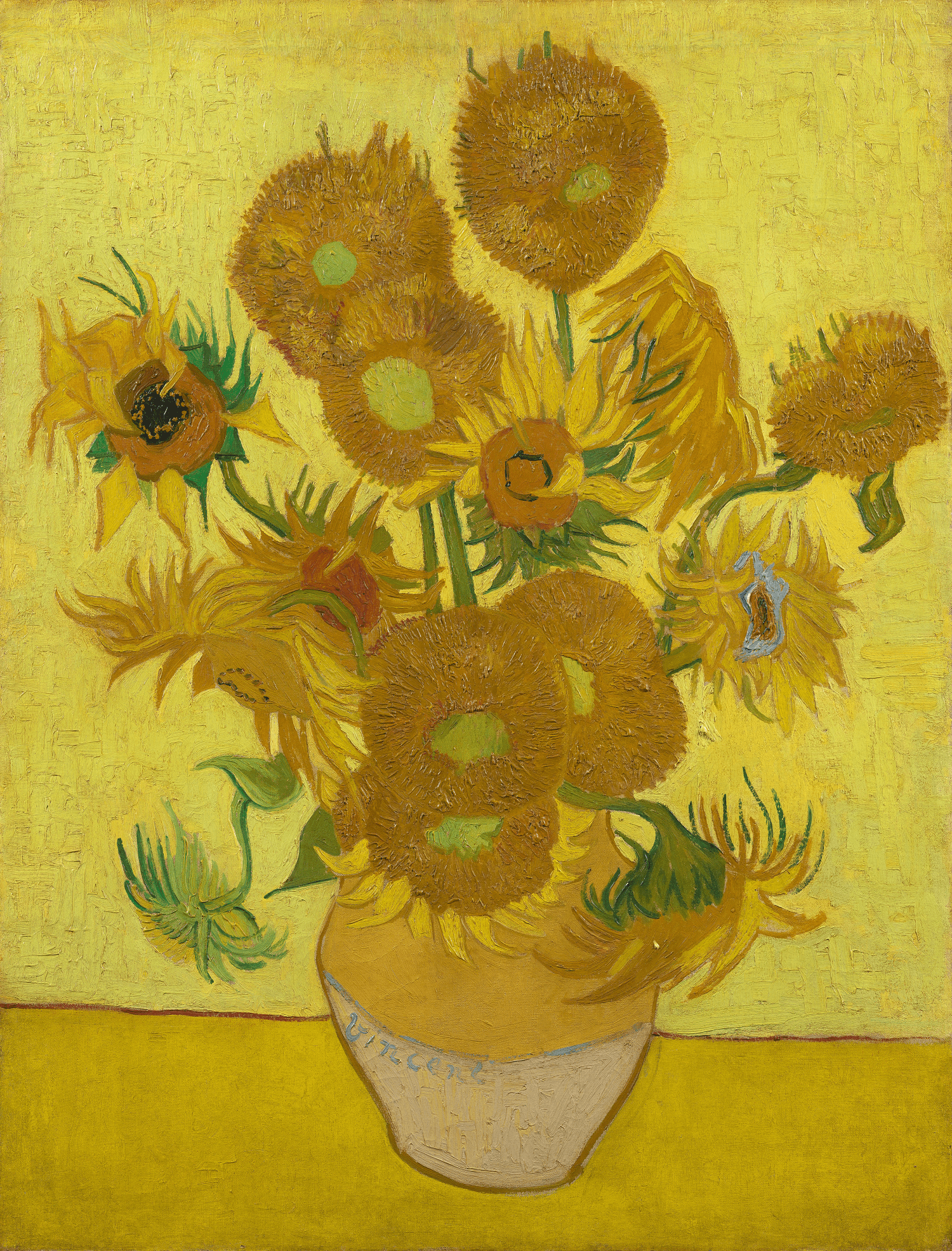
Sunflowers is not one painting: it’s a series. In Arles, between August 1888 and January 1889, Vincent van Gogh painted seven canvases of sunflowers in a vase, and before that, in Paris in 1887, four paintings of cut sunflowers. The Arles pictures, with their yellow on yellow, are now the painter’s emblem, and they are spread across London, Amsterdam, Munich, Philadelphia and Tokyo; one is in a private collection and another was destroyed in 1945. This page explains how many there are, why he painted them, what they meant to him and where to see each one.
The meaning of Sunflowers: why he painted them
In August 1888 Van Gogh was waiting for Paul Gauguin to arrive at the Yellow House in Arles and wanted to decorate his guest’s room. He told Theo about it on August 21 or 22 (letter 666 on vangoghletters.org): he was painting “with the gusto of a Marseillais eating bouillabaisse, which won’t surprise you when it’s a question of painting large Sunflowers.” He was planning a dozen canvases, “a symphony in blue and yellow,” which he worked on every morning from sunrise because the flowers wilted quickly.
For Van Gogh the sunflower stood for gratitude and was also a signature of his own. In January 1889, after Gauguin had left and after the ear crisis, he wrote to Theo (letter 741): “You know that Jeannin has the peony, Quost has the hollyhock, but I have the sunflower, in a way.” Gauguin, who had painted Vincent painting sunflowers, asked him for one of the canvases as a gift; Vincent was reluctant to give it to him and painted repetitions instead.
How many Sunflowers are there? The complete series
Paris, 1887: cut sunflowers
Four paintings of cut, dried sunflowers seen up close, painted in Paris in August and September 1887. One is in the Van Gogh Museum in Amsterdam (F 377), one in the Kunstmuseum Bern (F 376), one in the Metropolitan Museum of Art in New York (F 375) and one, the largest, in the Kröller-Müller Museum in Otterlo (F 452). Gauguin got two of them (the ones now in Bern and New York) in exchange for one of his own landscapes from Martinique, in a swap at the end of 1887.
Arles, August 1888: the first four
- Vase with Three Sunflowers (F 453): on a turquoise background. Private collection (United States).
- Vase with Five Sunflowers (F 459): on a royal blue background. Destroyed in Japan in 1945.
- Vase with Twelve Sunflowers (F 456): on a blue-green background. Neue Pinakothek, Munich.
- Vase with Fifteen Sunflowers (F 454): on a yellow background, the most famous. National Gallery, London.
Arles, January 1889: the three repetitions
- Repetition of the twelve sunflowers (F 455): Philadelphia Museum of Art.
- Repetition of the fifteen sunflowers, Tokyo version (F 457): Sompo Museum of Art, Tokyo.
- Repetition of the fifteen sunflowers, Amsterdam version (F 458): Van Gogh Museum, Amsterdam. This is the one you see on a visit to the Van Gogh Museum in Amsterdam.
In all, eleven sunflower paintings: four from Paris and seven from Arles. The two most often reproduced, the London and Amsterdam pictures, show the same composition: fifteen flowers in an earthenware vase with the signature “Vincent” on its belly.
Analysis: yellow on yellow
The color
The Arles sunflowers are an exercise in a single color. In the London picture, the background, the vase, the table and the flowers are all different yellows: light chrome, dark chrome, greenish yellow, ocher. Van Gogh made the most of chrome yellows, industrial pigments of the 19th century, and used them almost pure; recent research (2015) has shown that some of those yellows have darkened with exposure to light, and that the flowers were even brighter. The few blues and greens (the line on the vase, the stems, the edge of the table) make the yellow stand out.
The flowers
These are not fresh sunflowers: Van Gogh painted them in different states, some open, others without petals, showing the seed head, others already dry and drooping. Each center is built up with thick dabs of paint, with the texture of real seeds. Van Gogh paints the flower’s whole life cycle, not just its color.
The brushwork and the signature
The petals and centers are painted with quick, thick strokes; the background has a lighter crosshatching, and the strip of table is the smoothest, flattest area of the painting. The signature “Vincent” on the vase, as on a piece of pottery, is a way of saying that the painting and the object are his: his first name, never his surname, which the French couldn’t pronounce.
Fun facts
- The lost painting. Vase with Five Sunflowers was bought in 1920 by the Japanese collector Koyata Yamamoto; it burned in his home in Ashiya during an American bombing raid on August 6, 1945, the same day as the atomic bombing of Hiroshima. It is known only from reproductions made before 1945.
- The 1987 record. The Japanese insurance company Yasuda (now Sompo) paid $39.9 million for the Tokyo version at Christie’s, London, on March 30, 1987: more than three times the previous record for a painting. Eight months later another Van Gogh, Irises, beat it with $53.9 million at Sotheby’s, New York.
- Sunflowers at the wake. According to Émile Bernard’s account to the critic Albert Aurier, at Vincent’s wake in Auvers, on July 30, 1890, the body was surrounded by his last canvases and by heaps of yellow flowers, dahlias and sunflowers.
- Reunited. The London and Amsterdam versions were shown together in the Van Gogh Museum’s “Van Gogh at Work” exhibition (2013) and in the National Gallery’s “The Sunflowers” (2014). In 2024 the National Gallery showed the London and Philadelphia versions flanking La Berceuse, as Vincent had imagined, and in 2026 the London painting traveled to the Philadelphia Museum of Art for the exhibition “Van Gogh’s Sunflowers: A Symphony in Blue and Yellow” (June 6–October 11, 2026).
Where to see Sunflowers
Five can be seen in museums. London: National Gallery (fifteen sunflowers, 1888). Amsterdam: Van Gogh Museum (repetition, 1889). Munich: Neue Pinakothek (twelve sunflowers, 1888). Philadelphia: Philadelphia Museum of Art (repetition of the twelve, 1889). Tokyo: Sompo Museum of Art (repetition of the fifteen, 1889). For Amsterdam, the Van Gogh Museum tickets page explains prices and opening hours. Admission to the National Gallery’s collection is free; in 2026 its painting was on loan to the Philadelphia Museum of Art until October 11. The Sunflowers are also among our wallpapers and our coloring pages.
Fact sheet (London version)
| Title | Sunflowers (Dutch: Zonnebloemen) |
|---|---|
| Artist | Vincent van Gogh |
| Date and place | Arles, August 1888 |
| Medium | Oil on canvas |
| Size | 92.1 × 73 cm |
| Catalogs | F 454 · JH 1562 |
| Location | National Gallery, London (acquired in 1924 with the Courtauld Fund; at the National Gallery since 1961) |
| Period | Arles (1888–1889) |
Related works
- Vase with Fifteen Sunflowers: the London version, with its own page.
- Vase with Twelve Sunflowers: the Munich version.
- The Yellow House (1888): the house the sunflowers were meant to decorate.
- Gauguin’s Chair (1888): the guest they were painted for.
- Irises (1889): the other great flower painting.
Sources: letters 666 (to Theo, August 21 or 22, 1888) and 741 (to Theo, January 22, 1889), edition by the Van Gogh Museum and the Huygens Institute, vangoghletters.org; collection entries of the National Gallery (NG3863) and the Van Gogh Museum (s0031V1962); Wikipedia, “Sunflowers (Van Gogh series).”