
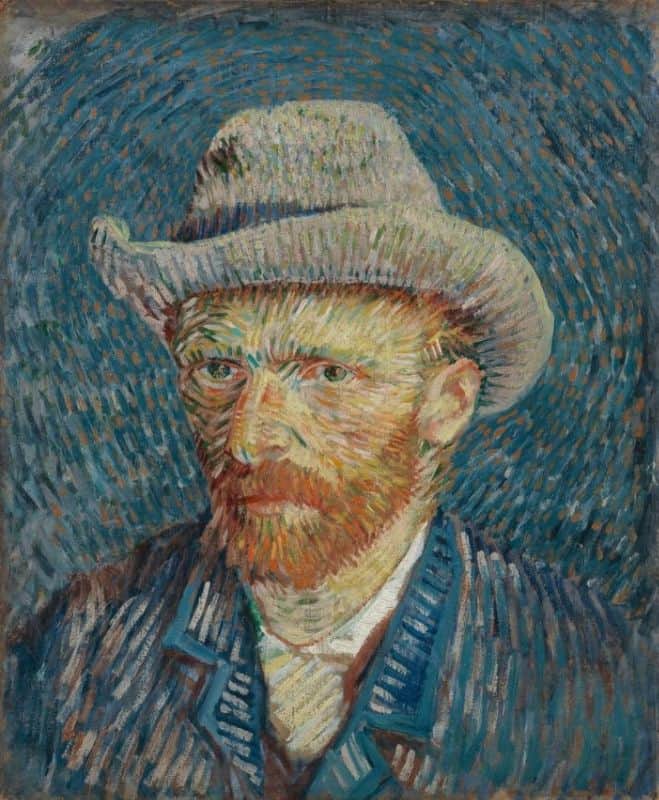
Vincent van Gogh was born on March 30, 1853, in Zundert, a village in Dutch Brabant, and died on July 29, 1890, in Auvers-sur-Oise, near Paris, at the age of 37. He didn’t decide to become a painter until he was 27, after failing as an art dealer, a teacher and a preacher, and in the ten years he had left he made more than 850 paintings and nearly 1,300 works on paper, almost none of which he sold. This biography follows his life stage by stage, using what he himself told his brother Theo in his letters, with links to the paintings from each period. If you’d rather start with the work, there are pages for each period: Nuenen, Paris, Arles, Saint-Rémy and Auvers.
Childhood in Zundert (1853–1869)
Vincent was the eldest son of the Protestant minister Theodorus van Gogh and Anna Carbentus, but not the first: a year earlier, on exactly the same day, another son, also named Vincent, had been stillborn. After him came three sisters and two brothers: Anna, Theo, Wil, Lies and Cor. According to the Van Gogh Museum, the family’s frequent walks in the countryside around Zundert instilled in him from childhood the love of nature that runs through all his work.
At eleven he moved from the village school to a boarding school in Zevenbergen, where he was deeply unhappy, although he finished primary school there. He drew now and then, with no sign yet of any special talent. At thirteen he entered the secondary school in Tilburg, where he got good grades, especially in languages; but halfway through his second year (1867–1868) he left for unknown reasons and never went back to school.
The art dealer: The Hague, London and Paris (1869–1876)
When he was sixteen, his uncle Vincent, “Uncle Cent,” got him an apprenticeship at the Hague branch of Goupil & Cie, the international art dealing firm; Uncle Cent had founded that branch himself. Vincent’s oldest surviving letter dates from those first years at Goupil. In September 1872 he began corresponding with his younger brother Theo, a correspondence that would last his whole life and is today the main source for understanding him; Theo joined Goupil in 1873, in Brussels, and that same year Vincent was transferred to the London branch.

In London he visited the British Museum and the National Gallery, where he admired the “peasant painters” such as Millet and Jules Breton, and he read everything, from museum guides to poetry. In 1875 he was transferred to Paris, and there he grew more and more religious: his letters to Theo from those months are full of Bible quotations and accounts of sermons. He cared less and less about the picture trade, and the feeling was mutual: in 1876 Goupil dismissed him.
Looking for a path: teacher, bookseller and preacher (1876–1880)
He went back to England as an unpaid assistant teacher at a boarding school in Ramsgate and then, for a small salary, at a school run by a minister in Isleworth, near London, where he was allowed to preach at the school and in the neighboring villages. The job had no future, and at Christmas 1876, at his parents’ home, his father advised him not to return to England. In January 1877 Uncle Cent came to the rescue again with a job at a bookshop in Dordrecht, but Vincent, more and more absorbed by religion, was already 24 and had no clear direction. His parents agreed that he should study theology. Since he hadn’t finished secondary school, he spent a year in Amsterdam, living with an uncle, preparing for the entrance exam with another uncle, a minister. He lacked discipline: he preferred walking around the city and the countryside, and in the end the uncle himself advised him to give it up.
He still wanted to serve God, and he went to Belgium as a lay preacher in the Borinage mining district. He taught, visited the sick and read the Bible. He lived among the miners and shared their poverty, slept on the floor and gave away whatever he had, so much so that they nicknamed him “the Christ of the coal mine.” “It’s a sombre place,” he wrote to Theo in April 1879, with workers “emaciated and pale owing to fever, who look exhausted and haggard, weather-beaten and prematurely old.” He did not manage to build a congregation, and his contract was not renewed.
In his letters to Theo he often included small sketches and sometimes a drawing of something he had seen. That habit led to the turning point of his life: Theo advised him to concentrate on drawing, and Vincent became convinced that he could also serve God as an artist. In October 1880, at 27, he settled in Brussels to work on his drawing technique and meet other artists. He no longer had a salary: Theo began sending him money, at first now and then and later regularly, until the end.
First steps as an artist (1881–1883)
In the spring of 1881 he went back to his parents, who now lived in Etten, also in Brabant, and practiced drawing, often outdoors. Theo, now manager of Goupil’s Paris branch, supported him so he could devote himself entirely to his art; his parents, on the other hand, were “extremely disappointed,” according to the museum, that their eldest son had chosen a life that to them amounted to social failure. It didn’t help that Vincent fell in love with his cousin Kee Vos, a widow, who wanted nothing to do with him and whom he insisted on courting. After a fight with his father, he left home on Christmas Day 1881: “Pa cannot empathize or sympathize with me, and I cannot settle in to Pa and Ma’s routine, it’s too constricting for me — it would suffocate me,” he had written to Theo a few days before.
He went to The Hague, where he took lessons from Anton Mauve, a celebrated painter married to one of his cousins, who taught him the basics of watercolor and oil painting; Vincent visited his studio almost every day and practiced “fanatically.” An uncle gave him his first commission, twelve drawings of views of The Hague, and then a second one, which taught him perspective. In early 1882 he met Sien Hoornik, a former prostitute who was pregnant and had a five-year-old daughter; she became his model and his companion. He scandalized his family and Mauve, but Vincent wanted to take care of her and rented a studio where the four of them lived. Theo disapproved of the relationship but kept sending him money. Sien is the model for Sorrow, the drawing he considered his best figure. The relationship lasted a year and a half.

After the breakup, in September 1883, he went alone to Drenthe, in the north of the Netherlands, to draw and paint the heaths and peat bogs. He found the landscape magnificent (“Drenthe is superb”), but, as he wrote to Theo from Nuenen in December, “staying there depends on many things — depends on whether one has the money for it, depends on whether one can endure the loneliness.” The rain, the cold and the isolation got the better of him in less than three months.

Painter of peasants: Nuenen and Antwerp (1883–1886)
In December 1883 he moved back in with his parents, now in Nuenen, another village in Brabant. He worked first in a small studio at the back of the parsonage and later rented a space in the village. Nuenen was the ideal place for a “peasant painter”: there were farmers, laborers and weavers, whom he drew and painted tirelessly. In early 1884 he offered Theo a deal: he would send him all his work in exchange for the monthly allowance, so that the money would be “money earned.” The idea was that Theo would sell the paintings in Paris, but French taste called for color, and Vincent’s work was decidedly dark.

His parents found him hard to live with: he was stubborn and careless about his clothes. Shortly after his father’s death at the end of March 1885, he began, in the studio he would move into that May, The Potato Eaters, “that thing with the peasants around a dish of potatoes in the evening,” prepared with many studies of peasant heads. Almost all his money went on materials. At the end of that year he decided to enroll at the fine arts academy in Antwerp, and he left the Netherlands, never to return.

Antwerp offered him good materials, drawing clubs with live models, and museums and churches full of art, but he found the academy classes unbearably traditional: “I actually find all the drawings I see there hopelessly bad — and fundamentally wrong,” he wrote to Theo in January 1886. Skull of a Skeleton with Burning Cigarette dates from those months. He agreed with Theo to come to Paris to study in Fernand Cormon’s studio; Theo began looking for an apartment for the two of them, but Vincent turned up unannounced at the end of February 1886: “Don’t be cross with me that I’ve come all of a sudden. I’ve thought about it so much and I think we’ll save time this way.”
Paris: from darkness to light (1886–1888)
Theo ran Goupil’s gallery (later Boussod, Valadon & Cie) on the Boulevard Montmartre and showed his brother the colorful work of modern artists such as Monet. In Cormon’s studio Vincent met a new generation: Toulouse-Lautrec, Émile Bernard. All these impressions pushed him to experiment, and the dark tones of The Potato Eaters soon gave way to lighter colors. He developed a short brushstroke of his own, changed subjects (cafés and boulevards, the banks of the Seine, flower still lifes) and tried more “commercial” genres such as portraiture; since models were expensive, he mostly painted himself: a large share of his self-portraits were painted in Paris.
He also discovered Japanese prints, which were sold in huge quantities in Paris and which he and Theo began to collect. Their bold outlines, their framing and their color contrasts show up immediately in his painting, as in his copy of Hiroshige’s Bridge in the Rain.

After two years, the hectic life of Paris became unbearable: “It seems to me almost impossible to be able to work in Paris, unless you have a refuge in which to recover and regain your peace of mind and self-composure,” he wrote to Theo on February 21, 1888, the day after arriving in Arles following a train journey of a day and a night. He longed for the countryside, the sun and the light of “Japanese” landscapes, which he hoped to find in Provence.
Arles: the Yellow House, Gauguin and the ear (1888–1889)
The light and colors of Arles thrilled him. He painted the orchards in bloom, the harvest, the boats at Saintes-Maries, and his style became looser and more expressive. With Theo he planned a “studio of the south,” an artists’ colony whose work Theo would sell in Paris: “You know I’ve always thought it ridiculous for painters to live alone &c. You always lose when you’re isolated.” For that purpose he rented four rooms in the Yellow House on Place Lamartine, and to decorate it he painted, among other things, the Sunflowers and his bedroom. Paul Gauguin was the first artist to move in there, and also the last. He arrived at the end of October 1888, after much insistence from Vincent and with the trip paid for by Theo.

The two worked hard, and their time together produced exceptional paintings, but they had very different ideas about art: Gauguin painted from memory and imagination; Vincent painted what was in front of him. “Gauguin and I talk a lot about Delacroix, Rembrandt &c. The discussion is excessively electric. We sometimes emerge from it with tired minds, like an electric battery after it’s run down,” Vincent wrote in mid-December. When Gauguin threatened to leave, the tension exploded. According to the Van Gogh Museum, Vincent, beside himself, threatened his friend with a razor, and that same night, December 23, 1888, he cut off his ear in the Yellow House, wrapped it in newspaper and handed it to a prostitute in the neighborhood. The whole story is in Van Gogh’s ear.

The next morning he was admitted to the hospital in Arles. Theo came by train as soon as he heard and wrote to Jo Bonger, whom he would marry months later: “Will he remain insane? The doctors think it possible, but daren’t yet say for certain.” Theo soon went back to Paris, and so did Gauguin: the dream of the shared studio had lasted two months. Vincent remembered little of the incident and, after leaving the hospital in early January 1889, went back to painting, including the two self-portraits with bandaged ear. But his mental health fluctuated a great deal in the following months and, fearing another attack, in May he himself asked to be admitted to the Saint-Paul-de-Mausole asylum in Saint-Rémy.

Saint-Rémy: a year in the asylum (1889–1890)
He entered Saint-Paul-de-Mausole on May 8, 1889, and got to work right away. On good days he painted in the hospital’s walled garden (Irises is from those first weeks), and later he was allowed out into the surrounding fields, the source of the wheat fields with cypresses and the olive trees. He was also given a room as a studio, where he painted, among other things, copies of prints by Millet and Rembrandt. His health kept fluctuating: during one phase of extreme confusion he even ate his paint, and for a while he was only allowed to draw. Even so, he was extraordinarily productive: about 150 paintings in one year, including The Starry Night. “As for me, my health is good, and as for the head it will, let’s hope, be a matter of time and patience,” he wrote to Theo in early June.
Theo had married Jo Bonger in April 1889, and in January 1890 Vincent received at the asylum the news of the birth of his nephew, who had been named after him, Vincent Willem. For the baby he painted Almond Blossom: “Large branches of white almond blossom against a blue sky,” to hang in Theo and Jo’s bedroom. And recognition was starting to come: six of his paintings were shown in Brussels with Les XX in early 1890, the critic Albert Aurier published a glowing article, and one of the paintings on show, The Red Vineyard, was sold. In March, ten of his works were shown at the Salon des Indépendants in Paris; “Gauguin said that your paintings are the key to the exhibition,” Theo told him.
Auvers-sur-Oise: the last months and his death (1890)
In May 1890 he left Saint-Rémy and settled in Auvers-sur-Oise, an artists’ village near Paris: quiet, but close to Theo, and with a doctor, Paul Gachet, an amateur painter, who could keep an eye on him. They became friends right away, Gachet advised him to devote himself entirely to painting, and Vincent painted the village’s gardens and wheat fields at a feverish pace, practically one painting a day: the church, the portrait of the doctor, the fields. His health seemed to be improving.
In early July he visited Theo in Paris and learned that his brother was thinking of leaving the gallery to start his own business, with all the financial risk that involved. He went back to Auvers worried: “my life, too, is attacked at the very root, my step also is faltering,” he wrote around July 10. Theo and Jo tried to reassure him, but the uncertainty and the fear that the attacks would return weighed too heavily. In that same letter he described his latest paintings, “immense stretches of wheatfields under turbulent skies,” in which he had tried “to express sadness, extreme loneliness”: Wheatfield under Thunderclouds and Wheatfield with Crows.
On July 27, 1890, he went out into the fields and shot himself in the chest with a pistol. Wounded, he walked back on his own to his room at the Ravoux inn. Theo came from Paris and was with him when he died, on July 29. He was buried in Auvers on July 30. He left more than two thousand paintings and works on paper; the Van Gogh Museum places Tree Roots, which he left unfinished, among the very last.

After his death: Theo, Jo and the museum
Six weeks later, Theo organized an exhibition in memory of his brother. His own health was deteriorating; he resigned from Boussod and suffered a severe nervous breakdown. Admitted to a psychiatric clinic near Utrecht, he died on January 25, 1891, barely half a year after Vincent. The collection passed to his widow, Jo van Gogh-Bonger, who moved to Bussum with her son and devoted herself to making Vincent’s work known by lending paintings to museums around the world; little by little, buyers appeared. In 1914 she published the first edition of Vincent’s letters to Theo, and that same year she had Theo’s remains moved to Auvers, to a grave beside his brother’s.
When Jo died in 1925, the collection passed to her son, the engineer Vincent Willem van Gogh, who lent it to the Stedelijk Museum in Amsterdam in 1930. In 1962 he transferred it to the Vincent van Gogh Foundation, and the Dutch state committed to building a museum and keeping the collection accessible forever. The Van Gogh Museum, in a building by Gerrit Rietveld, was opened by Queen Juliana on June 2, 1973, and today receives about two million visitors a year. Vincent had written to Theo from Arles in 1888: “The day will come, though, when people will see that they’re worth more than the cost of the paint and my subsistence, very meagre in fact, that we put into them.”
Frequently asked questions about Van Gogh’s life
When and where was Van Gogh born, and how did he die?
He was born on March 30, 1853, in Zundert (the Netherlands) and died on July 29, 1890, in Auvers-sur-Oise (France), at the age of 37, two days after shooting himself in the chest.
How many years did he paint?
About ten: he decided to become an artist in 1880, at 27, and died in 1890. In that time he made more than 850 paintings and nearly 1,300 works on paper; most of his famous paintings date from his last two and a half years.
Did he sell any paintings during his lifetime?
Very few, but more than one. The only one known by name is The Red Vineyard, bought by the painter Anna Boch at the Les XX exhibition in Brussels in 1890; according to the Van Gogh Museum, he also sold an early painting to the color merchant Julien Tanguy, Theo placed another with a gallery in London, and early on his uncle Cor commissioned nineteen views of The Hague from him, in two orders. Theo had been submitting his paintings to the Salon des Indépendants since 1888, and in March 1890 they were very well received.
What illness did he have?
There is no definite diagnosis. The doctors in Arles spoke of a “fièvre chaude” (hot fever) and of madness; Vincent suffered recurring attacks from December 1888 on, with long periods of lucidity in between, and he himself asked to be admitted at Saint-Rémy. What his letters make clear is that work was his way of holding on.
Sources: Van Gogh Museum, “Vincent’s Life, 1853–1890” (vangoghmuseum.nl, nine chapters) and “Vincent van Gogh FAQ”; letters quoted from the museum’s edition (vangoghletters.org); Wikipedia, “Vincent van Gogh” (dates).