
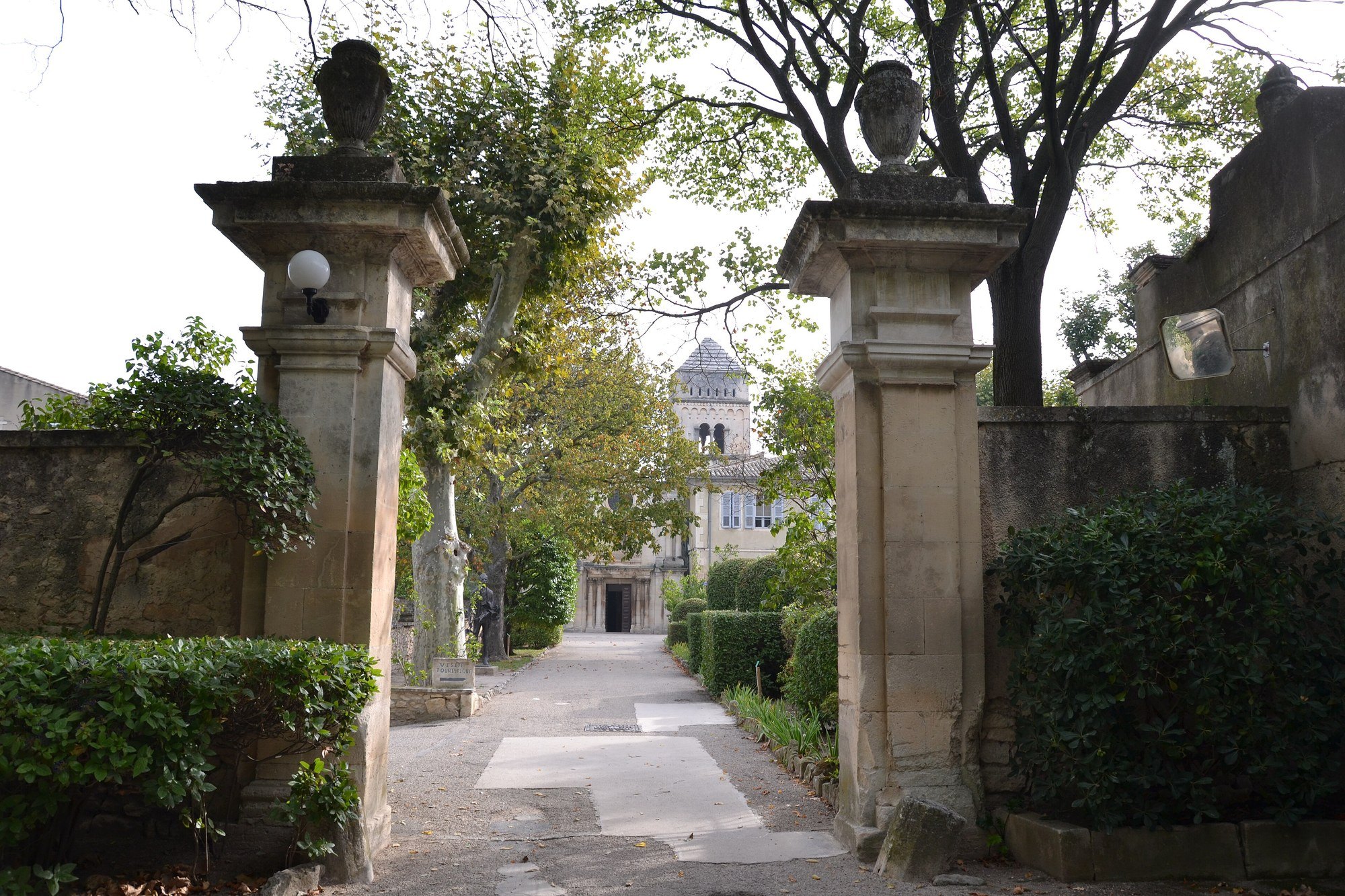
Header image: the entrance to the grounds of Saint-Paul-de-Mausole in Saint-Rémy-de-Provence, with the Romanesque bell tower in the background. Photo: Marianne Casamance, CC BY-SA 3.0, via Wikimedia Commons.
On May 8, 1889, Van Gogh voluntarily admitted himself to the asylum of Saint-Paul-de-Mausole in Saint-Rémy-de-Provence. He was given a spartan room where he spent 53 weeks, according to the monastery’s website: he left on May 16, 1890, the date the asylum’s director entered in his register. The Musée Estrine gives May 20, which is actually the day he arrived in Auvers-sur-Oise. During that year he painted the asylum garden, the fields he could see from his window, the olive groves around it and the mountains of the Alpilles.
Almost everything you can visit of Van Gogh in Saint-Rémy is inside the monastery itself or can be seen from it. Here are his places, with the works he painted at each one.
Van Gogh’s places in Saint-Rémy, one by one
Saint-Paul-de-Mausole: the bedroom and the studio
The monastery, which is still a psychiatric care center, has a cultural center open to the public. At the top of the Romanesque staircase it shows a reconstruction of Van Gogh’s bedroom and, across from it, one of his studio, similar to the rooms the doctor assigned him in the men’s wing.
Address: Chemin Saint-Paul, 13210 Saint-Rémy-de-Provence.
 Window in the Studio
 Vestibule in the Asylum
 Self-Portrait
 Portrait of a Patient in Saint-Paul Hospital
The cloister and church of Saint-Paul
The cloister, a masterpiece of Provençal Romanesque architecture, and the chapel with its bell tower are part of the visit. Van Gogh painted the church from the grounds.
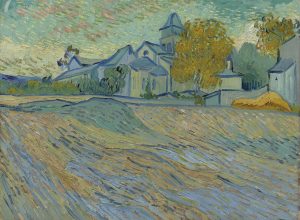
The garden and the avenue of reproductions
The center offers a botanical walk along the tree-lined avenue that leads to the chapel, with twenty reproductions of his major paintings. In the asylum garden he painted the irises, the lilacs, the pines, the ivy-covered trees and the stone bench.
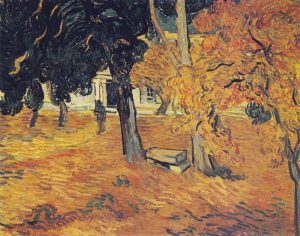 The Garden of Saint-Paul Hospital
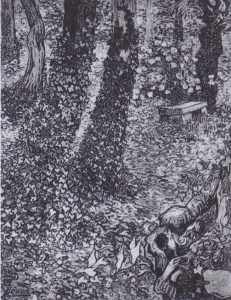 Trees with Ivy in the Garden of the Asylum
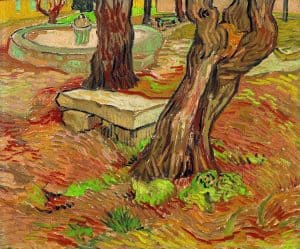 Stone Bench in the Garden of Saint-Paul Hospital
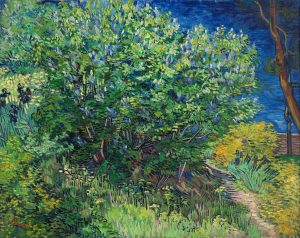 Lilac Bush
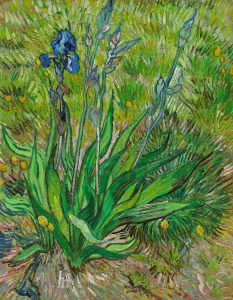 Iris
Iris Pine Trees in the Garden of the Asylum
 Fountain in the Garden of the Asylum
The “champ Van Gogh”
The visit also includes the “champ Van Gogh,” the enclosed field he could see from his window and which, according to the monastery’s website, he painted fourteen times: with green wheat, at sunrise, during the harvest. Today it is no longer a wheatfield but a garden with large-format reproductions of his paintings.
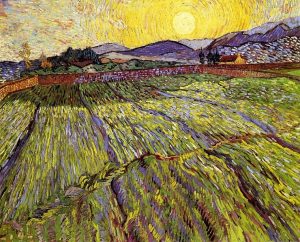 Enclosed Field with Rising Sun
 Enclosed Wheat Field with Rising Sun
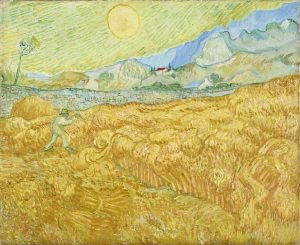 Wheatfield behind Saint-Paul Hospital with a Reaper
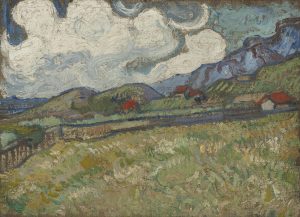 Wheatfield behind Saint-Paul Hospital
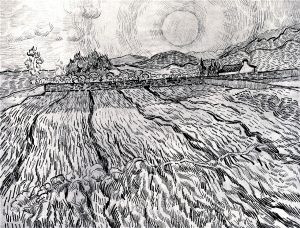 Enclosed Field behind Saint-Paul Hospital
The olive groves
“I’ve been working this month in the olive groves,” Van Gogh wrote to Theo on November 26, 1889 (letter 823). He painted the olive trees around the asylum in many versions.
According to the Musée Estrine, the landscape of Saint-Rémy and the foothills of the Alpilles is still today as he knew it, but there is no specific olive grove identified with his paintings that you can visit.
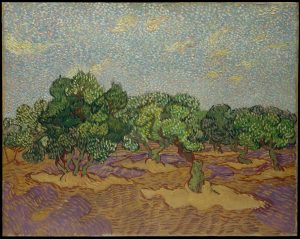 Olive Trees with Pale Blue Sky
 Olive Grove
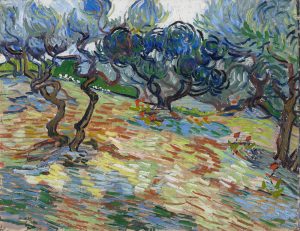 Olive Trees, Bright Blue Sky
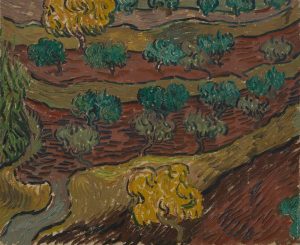 Olive Trees on a Hillside
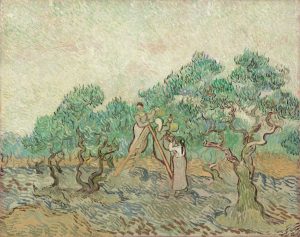 The Olive Orchard
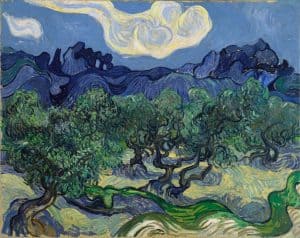 The Olive Trees
 Olive Grove with Two Olive Pickers
The Alpilles and Mont Gaussier
The Alpilles range, with Mont Gaussier towering over the asylum grounds, appears in several of his paintings and can still be seen from Saint-Rémy today.
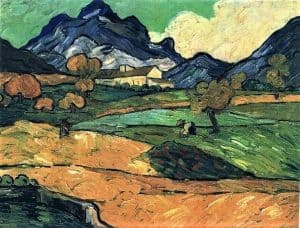 Mont Gaussier with the Mas de Saint-Paul
 View of the Alpilles
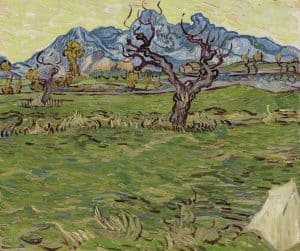 Fields near the Alpilles, or Landscape with Olive Tree and Mountains in the Background
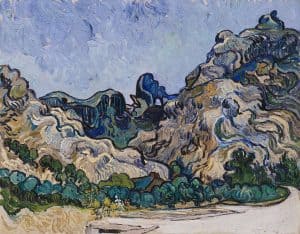 Mountains at Saint-Rémy
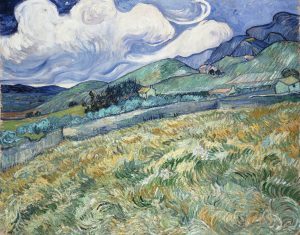 Mountainous Landscape behind Saint-Paul Hospital
Les Antiques and Glanum
Next to the asylum property stand Les Antiques, the Roman mausoleum and arch of the ancient town of Glanum, whose site has been excavated and is open to visitors. The sources we consulted do not link them to any specific painting by Van Gogh.
Museums and visits
Saint-Paul-de-Mausole. The monastery’s cultural center (Chemin Saint-Paul, 13210 Saint-Rémy-de-Provence) brings together the reconstructed bedroom and studio, the cloister, the chapel, the walk with reproductions and the “champ Van Gogh.” Its website says it will close for the winter starting January 4, 2027: check the dates before you go. Official website: saintpauldemausole.fr.
Musée Estrine – Vincent van Gogh Interpretation Center. A multimedia space on Van Gogh’s life, letters and influence, with a film about Van Gogh and the Alpilles. Official website: musee-estrine.fr.
How to get there and where to stay
Saint-Rémy-de-Provence has no train service: its station closed in 1950. The nearest high-speed station is Avignon TGV, about 20 km (12 miles) away, and the closest airports are Avignon, Nîmes and Marseille. To explore the town and the monastery, the practical choice is to stay in Saint-Rémy itself.
More about Van Gogh in Saint-Rémy
The whole period, with its main works, is covered in Saint-Rémy (1889–1890). To find out which museums around the world hold his paintings today, see where to see Van Gogh’s paintings.
Sources: official websites saintpauldemausole.fr and musee-estrine.fr; letter 823 in the Van Gogh Museum edition of the letters (vangoghletters.org); English Wikipedia articles “Saint-Paul Asylum, Saint-Rémy (Van Gogh series)” and “Glanum”; French Wikipedia article “Vincent van Gogh”; each work’s page on museovangogh.org; photo from Wikimedia Commons.